Words Build Teams: Why Terminology Matters in a Global Workforce
- August 21, 2026
- Posted by: admin
- Categories:

Words Build Teams: Why Terminology Matters in a Global WorkforceThe language firms use to describe global workforce can either support integration or quietly undermine it.
Most firms don’t intend to create distance between their U.S. teams and their global professionals. In fact, the opposite is usually true. They want global staff members to be highly integrated into the firm, aligned with internal processes, included in team communication, committed to quality, and connected to the culture.
Yet many firms still use language that sends a different message.
They refer to global professionals as “outsourced resources,” “offshore staff,” “contractors,” “vendor personnel,” or “the overseas team.” These terms may appear harmless. They may even feel familiar because they are common in the staffing and business process outsourcing marketplace. But language does more than describe a workforce model. It shapes how people understand roles, relationships, expectations, and status.
If a firm wants global professionals to perform like true members of the organization, it should be careful not to describe them in ways that make them sound separate from the organization.
That’s not simply a matter of politeness. It is a matter of leadership, integration, and performance.
Outsourcing Language Creates Distance
The word outsourcing carries a long history of transactional meaning. In many business contexts, outsourcing suggests that a company has handed work to an outside provider. The focus is often on cost, capacity, transfer of tasks, or the delegation of a function to someone external.
That may be accurate in some circumstances. But it’s often the wrong language for firms that are building integrated global teams.
When U.S. professionals hear that work has been “outsourced,” they may unconsciously treat the people performing that work as external to the firm. They may share less context. They may invest less time in coaching. They may provide instructions instead of training. They may review work as if it came from a vendor rather than from a colleague who is trying to learn the firm’s expectations.
The global professional hears the message too.
If someone is repeatedly described as outsourced, the implied message is that they are outside the core team. They may be included in workflows but excluded from culture. They may be assigned work but not developed. They may be expected to deliver quality but not invited into the learning environment that produces quality.
That gap matters.
Research on organizational identification defines the concept as a person’s sense of belonging within the organization and has found positive relationships between organizational identification, work engagement, and job satisfaction.
A similar study on social identity theory shows that employees who feel connected to the organization tend to be more engaged and more aligned with organizational goals. This research supports an important principle: people who feel like they belong are more likely to invest vigor, creativity, and dedication into the work relationship, helping the organization with purpose and meaning.
If the goal is integration, terminology should reinforce belonging, not separation.
Offshoring Can Also Send the Wrong Signal
“Offshoring” is often used as a geographic term. It describes where work is performed, not necessarily the quality, importance, or professional standing of the people performing it. Still, the term can carry negative connotations.
Something to keep in mind when building a global team is:
- Don’t let location define professional identity.
- Time zones and compliance matter, status doesn’t.
- Acknowledge location without creating distance.
For many U.S. professionals, “offshore” has become shorthand for lower-cost labor, time zone challenges, communication friction, or work that has been moved away from the core business.
For the global teams, the term can feel reductive and dismissive. It defines the professional by location rather than contribution. It sends across the wrong message to the talent working remotely.
If a company reduces their global colleague to geography, they risk losing a valuable piece that may be the perfect fit for the position the organization needs. Reducing a global professional because of their location is a fatal error more common than it should be. In today’s global environment, talent can be anywhere and location shouldn’t matter, unless it’s an operational matter.
A global workforce model involves different time zones, holidays, communication norms, and compliance requirements. But geography shouldn’t become status. A firm can acknowledge where people work without describing them in a way that makes them feel “outsiders”. Everyone in the team should be heading towards the same goal, with the same opportunities to grow.
Better Terms Build Better Expectations
Stronger terms include:
- Global team member
- Global professional
- International team member
- International workforce
- Global colleague
- Integrated global team member
- Cross-border team member
- Global delivery professional
- International professional
- Distributed team member
- Member of our global workforce
- Colleague in our international team
The best terminology does three things:
- It recognizes professional identity: Global professionals are not merely capacity. They are people with skills, experience, judgment, and aspirations.
- It reinforces integration: The language says they are part of the same team, not a separate class of worker.
- It raises expectations: Global colleagues receive coaching, context, communication, and opportunities to grow.
Language Influences Behavior
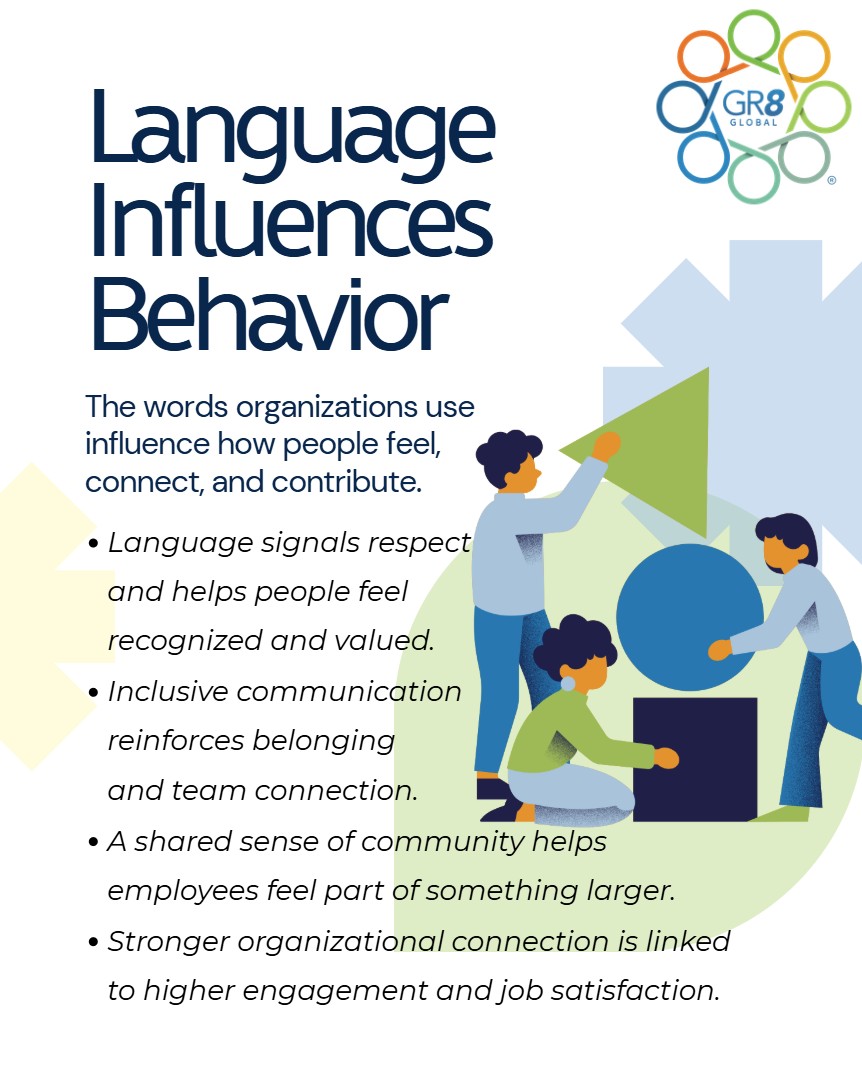
The research indicates that the sense of belonging and performance are connected.
The American Psychological Association’s Inclusive Language Guide notes that language should show respect for how people identify themselves and emphasizes that terminology can influence whether individuals feel recognized and included. This principle applies beyond diversity discussions and serves as a useful reminder that people are affected by how organizations describe them.
Similarly, practitioner research from ICAEW highlights the connection between inclusive language and a sense of belonging in the workplace. Their analysis suggests that language helps shape whether employees feel respected, included, and part of the broader organizational community.
Research on organizational identification reinforces this point. Employees who feel connected to the organization tend to exhibit higher levels of engagement and job satisfaction.
The way organizations describe employees affects how they’re viewed and how they feel in their workplace. When terminology reinforces belonging, firms create conditions that support engagement, commitment, and stronger relationships.
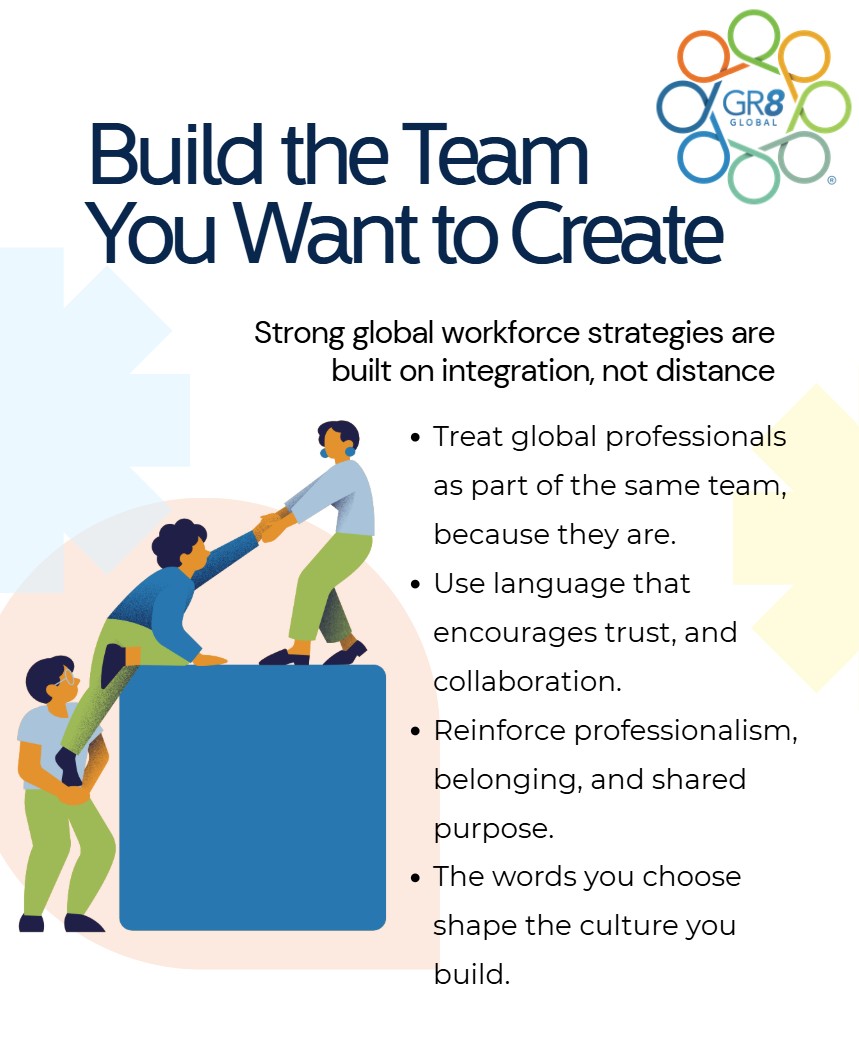
Build the Team You Want to Create
Strong global workforce strategies are built on integration, not distance.
If global professionals are treated as distant vendors, firms often experience recurring frustration: limited ownership, repeated training gaps, inconsistent communication, and weaker integration. The problem may look like a performance issue, when the root cause is often how the relationship was designed.
Language will not solve every integration challenge. Firms still need clear roles, strong onboarding, documented processes, effective review structures, technology access, communication norms, and leadership accountability.
But language sets the tone for all of those practices.
A firm cannot build a truly integrated global team while consistently using terminology that implies separation.
Leaders should be deliberate about the words they use in internal meetings, onboarding materials, client conversations, emails, org charts, workflow tools, and performance discussions. Here are some examples:
❌ Instead of saying: “We outsourced this work.”
✅ Say: “Our global team is supporting this work.”
❌ Instead of saying: “Send it to the offshore team.”
✅ Say: “Please coordinate with our global colleagues.”
❌ Instead of saying: “The contractor will handle that.”
✅ Say: “A member of our international team will support that process.”
❌ Instead of saying: “They’re not our employees.”
✅ Say: “They’re part of our integrated delivery model.”
These shifts are small, but they signal a different philosophy. They tell U.S. professionals that global colleagues deserve context, respect, development, and inclusion.
If a firm wants global professionals to behave like valued members of the organization, it should describe them that way. If it wants U.S. professionals to coach, include, trust, and collaborate with global colleagues, it should use language that supports those behaviors.
For firms building long-term global workforce models, the terminology should match the ambition. These professionals are not “outsourced resources.” They’re not merely “offshore staff.” They are global colleagues, international professionals, and members of an integrated team.
That’s not just better language.
It’s better leadership.