
Talent Crisis in Professional Services Firms: How does it happen?
Learn how a talent crisis happens in professional services firms and how to prevent it, in the words of Brett Loxterman, Managing Director of Growth at GR8 Global.
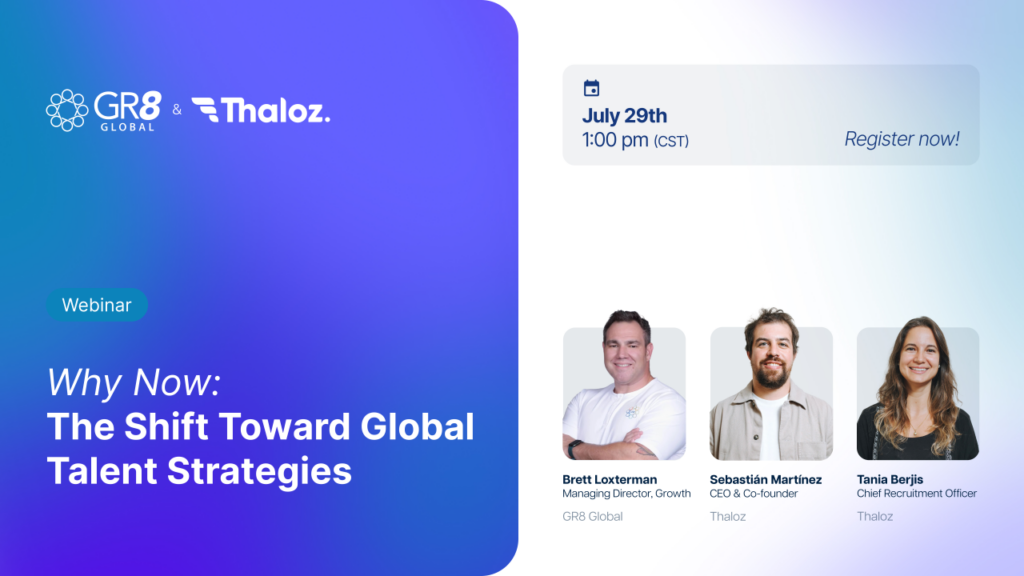
GR8 Global participated in the Webinar Why Now: The Shift Toward Global Talent Strategies, conducted by the IT consulting and nearshore talent services firm, Thaloz. Brett Loxterman, Managing Director of Growth at GR8 Global, explores how talent crises develop in professional services firms. Many companies assume their hiring system is working until they find out, often too late, that they don’t have enough capacity to hold their growth in the long-term. Expansion requires people, a lot of that talent can be found globally, and many positions can be filled remotely.
Brett compares talent crisis in professional services firms to bankruptcy.
“It all starts with capacity. You know that’s where firms’ kind of feel it at the very first moment. It’s like the concept of bankruptcy. You think, how did that happen? Well, it happened very slowly and then all at once. And that happens in the same way when you try to find talent. All of the sudden, you may realize that you’re behind in terms of the talent that you want to expand your company and scale out.
Why Mid-Sized Firms Face Greater Talent Shortages
Based on his experience, Brett Loxterman has observed that mid-sized companies struggle most to find top talent as the U.S. labor market is repriced.
“Folks that are in that mid-level portion of their career, maybe eight to ten years of experience, are just demanding a higher salary. And so, ultimately, that shrinks down the pool of individuals that companies can go and find. Unless you have super deep pockets and you’re trying to buy a candidate. The mid-level companies that we work with just really struggle to find top talent.”
Mid-sized professional services firms don’t usually have enough budget to expand as much as they want due to shrinking talent pools and rising salaries. As experienced professionals demand more compensation and continue to retire, the hiring reality is shifting. The mindset needs to shift as well to adapt to these new conditions. As the talent gap widens, mid-sized companies struggle to find the resources they need to expand while ensuring customer expectations continue to be met.
How Global Talent Expands Hiring Capacity
Many companies are looking at Global Capability Centers (GCCs) as a way to overcome these new constraints. Professional services firms face a margin pressure as labor costs continue to rise. As a result, companies often spend more to secure the talent they need while generating less profit. This challenge is particularly pronounced for mid-sized firms, which may not have the resources to compete for professionals in a limited talent market. While GCCs can help reduce expenses, for Brett Loxterman, the value of global teams extends far beyond cost savings.
“Some of the things that’s beneficial as part of the GCC build is that you get a little bit of cost savings. But that’s not the only thing that we focus on. And ultimately, what we’re trying to find is those leaders that are looking to take action the right way. They’re solving the problems they need to and thinking outside the box by looking at Global Capability Centers.”
As a fact, hiring locally costs more than before. Smart leaders address this challenge by finding talented people around the world instead of limiting their search to U.S. talent. While there was once a common perception that remote workers wouldn’t be effective in certain industries, the reality is that every industry has roles that can be done remotely. That’s why more leaders are tapping into global talent, now that access and managing global teams is easier than ever.
Red Flags Leaders Often Miss
-
Rising workloads across existing teams
-
Increased employee burnout
-
Delayed project delivery
-
Difficulty finding experienced professionals
-
Reliance on overtime to meet client demands
-
Lower profit margins caused by rising labor costs
-
Growth plans that repeatedly stall due to hiring challenges
How to Spot a Talent Crisis Before It Happens:
5 Warning Signs
Based on Brett Loxterman’s insights, many firms don’t realize they’re facing a talent shortage until growth begins to stall. Workloads build, meeting client demands becomes more challenging, and hiring grows increasingly difficult. Here are five warning signs to prevent a talent crisis from happening:
1. Specialized roles stay open for too long:
Specialized positions are usually the hardest to fill. This is a sign that your hiring strategy limits your access to the talent needed. One of the most common indicators that something is not working properly is when open positions remain unfilled for extended periods of time. As a result, the company doesn’t grow in the way that role was intended to support, yet the chair remains empty.
2. Salary expectations exceed your hiring budget:
Another sign that a firm is falling behind in talent is when salary expectations exceed the hiring budgets. Rising compensation, professional retirements, and ongoing demand make it harder to compete for local talent, especially for mid-sized firms. These pressures create capacity constraints that limit growth.
3. The firm doesn’t have talent governance:
If no one in the firm is responsible for workforce planning, human resources, recruiting strategies, and talent development, it may be a sign that you’re falling behind and setting the stage for a talent crisis in the long run.
It’s important to have dedicated HR leadership. Employees should know the face of the leader responsible for them while they’re in the company. That creates a sense of security and trust. When there’s a clear HR leader, the risk diminishes. This person should oversee the attraction and retention of top talent, support workforce growth, and ensure team integration and development. Without that structure, talent can be lost, hiring challenges can quickly compound and backfire, creating setbacks that are much harder to overcome.
4. Replacement instead of long-term capacity
Although the firm may have an excellent team, the growth horizons are still restricted by local talent availability. Eventually, many of those professionals will reach retirement age, leaving behind critical roles that require years of experience to fill. You may find that the talent you’re looking for simply isn’t available in the United States. The professionals you need may be in the Philippines, India, or Latin America instead.
The difference between replacing a single employee and building a global team for the long term can significantly impact the company’s growth capacity. By expanding your talent search globally, you can accomplish more, gain access to experienced professionals, and reduce the hiring complexity without establishing local entities. In addition to that, having an international team means you can extend the traditional working hours. Global talent enables operational coverage across time zones, keeping the momentum after U.S. teams have logged off for the day.
5. Talent search is limited to the U.S.
Another warning sign is overreliance on local talent markets. Many leaders are skeptical about remote work in other countries, while competitors are expanding their reach globally. Restricting hiring efforts to a single market, can reduce access to qualified professionals and increase recruiting costs.
Leadership assumptions about global teams can create significant growth challenges for a firm. Negative experiences often create a stigma around global professionals, or lead managers to view the GCC model itself as ineffective instead of reframing their thinking. Rather than concluding that “all global teams are bad,” a more productive mindset is, “I didn’t have the right tools, processes, or support to make the global team work.”
Successful teams are built through deliberate investment in people, not through a plug-and-play mentality. Firms that expect new hires to be immediately productive underestimate the importance of onboarding, training, integration, and ongoing support. Without these elements in place, even highly talented professionals may struggle to reach their full potential.
What Firm Leaders Need To Do Next
In conclusion, commitment is an essential part of the growth process for every professional services firm. Growth doesn’t happen overnight, and it requires many moving parts working together to be successful. It must be an ongoing, intentional effort. One way to achieve this is by partnering with experts in recruiting, human resources, and workforce development. That’s why many leaders choose to delegate these responsibilities and partner with a GCC that can meet their talent needs while they continue focusing on serving their clients.
With increased capacity, firms can take on more clients without sacrificing service quality. They are also more confident in building remote teams because they have the right structure, support, and expertise in place. This allows company leaders to focus on what they do best: improving their services, refining their processes, and driving growth, rather than worrying about a potential talent crisis caused by talent shortages, retirements, market constraints, or other factors that can lead to growth stall.